2025 Recap: Learning to Show Up
- Müge Kahraman

- Dec 24, 2025
- 6 min read

2025 has been a year of pause, clarity, and movement all at once.
I created Living Cult, and another project very close to me, Armour of Body, back in 2021, after a difficult period marked by lockdowns and unemployment. During that time, I realized I had been quietly building two parallel archives without fully acknowledging them: a large collection of interior and product design imagery, and an equally extensive body of jewelry design work. Living Cult took off rather quickly, and through that process I became certain of something that had previously felt unclear. I wanted to focus on interior design alone, rather than continuing in roles that blended architecture and interiors, as many of my previous jobs had.
With that realization, I decided to work in a dedicated interior design studio. My intention was not only to refine my design thinking, but also to understand materials more deeply and to meet the craftsmen and workshops that shape the industry from the inside. At the same time, I had a long-standing desire to design and produce my own objects, and I knew I needed to engage with that ambition more seriously. Thankfully, my boss and colleagues were unusually supportive, especially when compared to many other work environments. They helped connect me with the right people and places, and gave me space to explore beyond the boundaries of my role.

That job gave me exactly what I needed at the time, and as a result, I launched Baggage Claim Mirrors in the fall of 2022. However, while I was learning how to build products with workshops and craftsmen, I was also confronting another unfamiliar territory: promotion. I had little experience in advertising, visibility, or actively reaching out to people, not only to sell, but to enter a community. I worked with several platforms that proved inefficient, and until 2024 I continued working as an interior designer, occasionally as an architect, both freelance and employed, while slowly pushing the mirrors forward.
Toward the end of 2024, I made a deliberate decision to invest in presence. I budgeted to attend a design week, hoping to connect with people like me: young designers who were still finding their footing and often working alone. I applied to take part in Isola Design’s Milan Design Week 2025 exhibition, Design is Human, and although it may sound dramatic, the experience shifted my perspective almost entirely.
What Milan clarified for me was simple but powerful. Good design is one thing; bringing it into the right conversations, at the right places, is another. Design is not an isolated act. It moves in a shared rhythm between makers, curators, galleries, brands, and audiences. Recognition does not come from standing alone, but from being seen in relation to others. These encounters expand your understanding of your own work; they humble you, but they also encourage you.
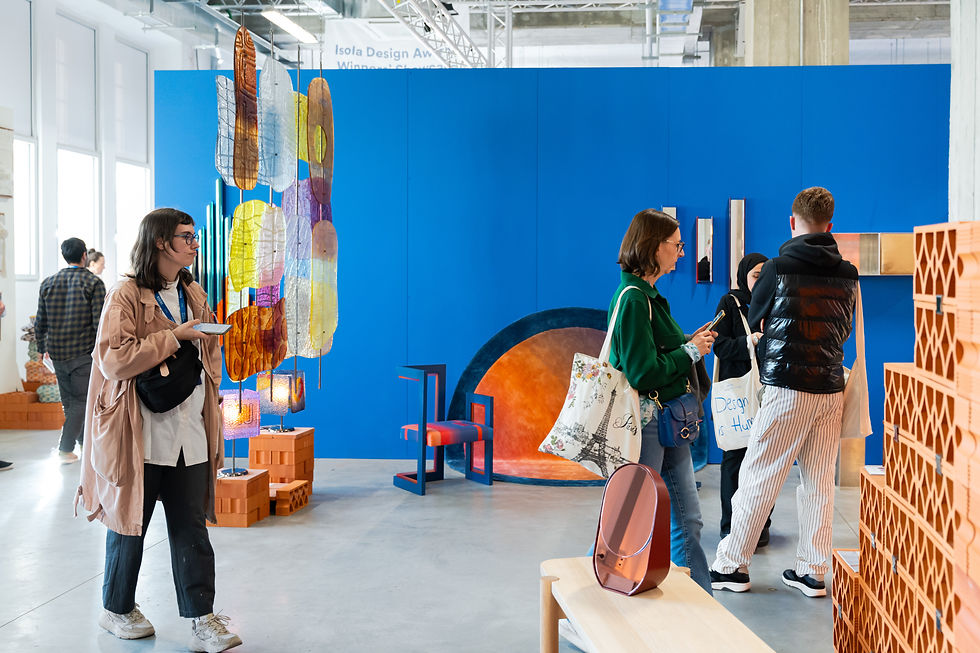
Image Courtesy Isola Design
Walking through exhibitions, watching crowds move with excitement from one space to another, I realized how many rooms exist for engagement, and how many of them I had previously assumed were inaccessible. Seeing this made something shift. Those rooms, whether large or small, are the ones worth stepping into.
After Milan, I decided to reach out to some of the galleries I admire most. As expected, responses were few and often slow. This did not discourage me, I trusted the approach I had developed with my mirrors, but I also began to understand that time is an essential part of building a practice. Perhaps I needed a broader catalogue, a more layered body of work. What stood out to me about these galleries was not only their reach, but the way they gathered creative communities around themselves. I wanted my work to exist in dialogue, within curated contexts where it could be experienced alongside others.
One response, however, arrived quickly. Within an hour of sending my email, Tuleste Factory in New York replied with interest. By September, my mirrors officially became part of their collection. Tuleste Factory has a strong and recognizable identity: vibrant, intentional, and open to emerging voices. Their use of color and form feels confident and contemporary, and I could easily imagine my mirrors existing within that visual conversation. They understand that showing up, consistently and visibly, creates a new rhythm for both galleries and designers. Their approach to promotion feels bold and narrative-driven, with a confidence that shows in both their attitude and booth designs.

Image Courtesy Tuleste Factory and Matthew Gordon Studio
That September, Tuleste Factory participated in Collectible New York with their exhibition AFTERGLOW. The booth carried a distinct pink palette, bold yet cohesive, bringing together designers and artists whose works complemented one another naturally. Although I couldn’t attend in person, a reality many experience due to political and logistical limitations, I sent one piece: Baggage Claim-M, the tabletop mirror I had also shown in Milan. Following the fair from afar, I could still sense the energy. There is something magnetic about these events: the circulation of people, the quick exchanges, the spontaneous conversations that spark future ideas. Even from a distance, it felt meaningful to know my work was part of that atmosphere.
What stands out most about events like Milan Design Week or Collectible New York is not only exposure, but the sense of community they create. Amid the visual noise, real connections emerge. Conversations turn into friendships, collaborations, or quiet forms of mutual recognition. You encounter designers from different disciplines, gallery owners, photographers, writers, all brought together by shared curiosity. These moments allow different creative worlds to overlap in ways that feel both unexpected and generous.

Alongside this global journey, there is another layer that has shaped my path. Many designers begin their careers through local networks, but as a Turkish designer, I have often found it difficult to access a sustained sense of community at home. Wanting to be global is one thing; feeling pushed outward due to local conditions is another. One of the questions I am asked most frequently is why I create content in English and focus internationally. This choice was not entirely strategic. It was instinctive. I felt that the possibilities for connection were broader abroad.
This does not mean I lack interest in local dialogue. Turkey has many designers producing strong and thoughtful work. Yet local communities often remain fragmented, circulating within small, closed circles. That belief was gently challenged when I received an email from Studio Mercado, inviting me to take part in the opening exhibition of their new space, Mercado Lab in Istanbul. Studio Mercado is an online platform known for podcasts and events created in collaboration with designers across disciplines. I had been following their work for some time, and learning that they were opening a physical space to address this exact gap felt hopeful.
I joined their exhibition, RED END, a festive and fitting title aligned with their brand identity. Six designers participated in total (alongside Living Cult; Meta Studio, Hakan Kemal Design, Sou Forms, Yet Design Studio and Tomas Atelier), and all of us shared similar reflections on how difficult it can be to stay connected locally. Meeting through this exhibition opened new lines of dialogue and collaboration. The opening was full of energy, revealing how many people are seeking connection and actively trying to build it. It gave me renewed optimism for local design communities, not only for designers, but for everyone involved in the broader design ecosystem. As a small personal note, the space being only a five-minute walk from my apartment made the experience feel even more grounded in daily life.

These experiences continue to remind me that networking is not primarily about strategy, it is about shared passion. When asked how these events help from a business perspective, the answer is rarely immediate. They pave the way for future moments, where connections slowly align and take shape. Relationships formed in these contexts grow through exchange and mutual inspiration, not urgency.
Since Milan, I have been more intentional about building these connections, not only for visibility, but for belonging. Working with a professional gallery marked an early step in that direction. Whether this collaboration expands or transforms, it represents an important bridge, extending my work beyond local boundaries.
Although Living Cult began in 2021, 2025 is the year I fully committed to giving it a real chance. Seeing how much can shift within a single year has made one thing clear: reaching the places you want to be is not impossible, whether in business or in connection. Nothing is built overnight, but brick by brick, the process itself becomes the reward.
*All photographs and videos featured in this article were captured by the author unless a specific image states otherwise.